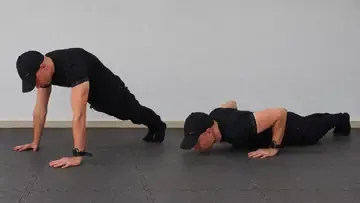
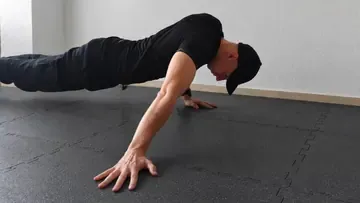
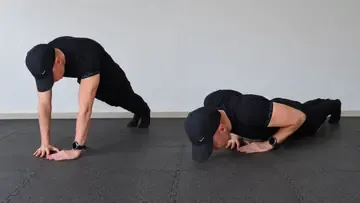
Set a wide hand position
Place your hands on the floor wider than shoulder-width apart, with your fingers pointing forward or slightly outward. Choose a width that allows comfortable shoulder movement.
 dynamic
Begin in a high plank with your hands placed wider than shoulder-width apart and your feet extended behind you. Keep your body aligned from head to heels while engaging your core and glutes. Bend both elbows simultaneously to lower your chest towards the floor, allowing your elbows to move outward at a comfortable angle. Press through both palms to extend your arms and return to the starting position. Maintain symmetrical movement and avoid using an excessively wide hand position that compromises shoulder comfort or control.
Place your hands on the floor wider than shoulder-width apart, with your fingers pointing forward or slightly outward. Choose a width that allows comfortable shoulder movement.
Extend your legs behind you and support your body on your hands and toes. Brace your abdominals and glutes to maintain a straight line from your head to your heels.
Bend both elbows simultaneously and lower your chest towards the floor. Keep your shoulders controlled and avoid allowing your elbows to flare excessively.
Press firmly through both palms and extend your elbows to raise your body. Keep your hips and shoulders moving together without shifting your weight to one side.
Return to the starting plank with your arms extended and your body aligned. Maintain control before beginning the next repetition.
An extreme hand width can reduce your usable range of motion and place unnecessary stress on the shoulders. Use a moderate width that allows controlled movement.
Avoid forcing your upper arms directly out to the sides at a 90-degree angle to your torso. Keep your elbows at a comfortable angle to maintain shoulder control.
Do not use the wider hand position as an excuse to perform very short repetitions. Lower through a comfortable range while maintaining proper shoulder alignment.
Allowing your pelvis to drop creates excessive lower-back extension. Maintain abdominal and glute tension throughout the movement.
The Wide Push Up is a symmetrical pushing exercise. Avoid shifting most of your bodyweight to one side, which changes the movement towards an Archer Push Up.
Avoid bouncing at the bottom or using momentum to return to the top. Maintain a controlled descent and smooth pushing phase.
A Wide Push Up is a Push Up variation performed with the hands positioned farther apart than shoulder-width. Both arms bend and extend together while the body remains aligned.
Wide Push Ups primarily train the pectorals and anterior deltoids, with the triceps assisting elbow extension. The serratus anterior and core muscles contribute to shoulder stability and body alignment.
A wider hand position changes shoulder and elbow mechanics and can increase the relative emphasis on the pectorals. However, muscle activation depends on technique and hand width, and an excessively wide grip does not necessarily produce better results.
Not necessarily. A wider hand position can reduce the range of motion and change the leverage. Some athletes find Wide Push Ups easier, while others experience greater shoulder demands.
Wide Push Ups involve bending both elbows simultaneously while keeping the body centered. Archer Push Ups shift most of the bodyweight towards one arm while the opposite arm remains nearly straight.
Start with your hands moderately wider than shoulder-width apart and adjust according to your mobility and comfort. Avoid extreme widths that force your shoulders into an uncomfortable position.