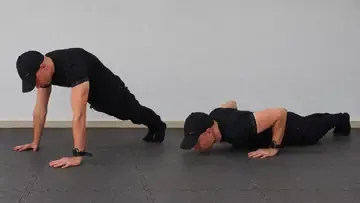
Set a wide hand position
Begin in a high plank with your hands placed much wider than shoulder-width apart. Keep your elbows extended, legs straight, and core engaged.
 dynamic
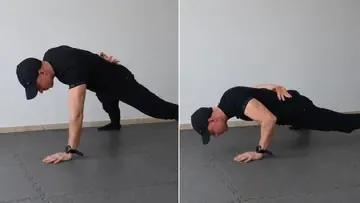
Begin in a high plank with your hands positioned significantly wider than shoulder-width apart. Keep your body straight and your core engaged. Shift your weight towards one hand while bending that elbow and lowering your chest towards the working side. The opposite arm remains extended to the side, providing balance and partial assistance. Press through the bent arm to return to the starting position, then repeat on the opposite side. Maintain controlled movement and avoid rotating or twisting your torso excessively.
Begin in a high plank with your hands placed much wider than shoulder-width apart. Keep your elbows extended, legs straight, and core engaged.
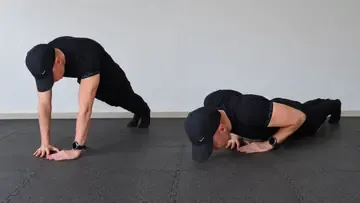
Move your upper body towards one hand while keeping your hips and shoulders aligned. Allow the opposite arm to extend outwards as your weight shifts towards the working side.
Bend the working elbow and lower your chest towards that hand. Keep the opposite arm nearly straight and maintain a rigid body position from head to heels.
Press strongly through the working hand to extend your elbow and move your torso back towards the center. Avoid twisting your hips or using momentum.
Shift your weight towards the other hand and repeat the movement with the opposite arm. Maintain a consistent range of motion and controlled technique on both sides.
The Archer Push Up requires one arm to perform most of the pushing while the opposite arm remains nearly straight. Bending both elbows equally turns the exercise into a wide Push Up.
Keeping your torso centered between both hands reduces the unilateral strength demand. Move your chest towards the working arm during the lowering phase.
Avoid twisting your pelvis or opening your torso excessively towards the working side. Keep your hips and shoulders as aligned as possible.
Lower your chest towards the working hand through a controlled range rather than performing only a shallow elbow bend.
Maintain abdominal and glute tension throughout the exercise. Avoid arching your lower back or allowing your hips to drop.
An unnecessarily wide grip can create excessive shoulder stress and reduce control. Choose a width that allows the supporting arm to remain extended without forcing an uncomfortable position.
The Archer Push Up is a unilateral pushing variation where one arm bends to support most of the bodyweight while the opposite arm stays nearly straight and provides assistance.
Archer Push Ups primarily work the pectorals, triceps, and anterior deltoids. The serratus anterior and core muscles help stabilize the shoulders and prevent excessive body rotation.
Yes. Archer Push Ups shift more bodyweight towards one arm, increasing the strength and stability demands compared with a standard Push Up.
Yes. They are a useful progression because they increase the load on one arm while allowing the opposite hand to provide assistance. Gradually reducing that assistance can help prepare for a strict One Arm Push Up.
The supporting arm should remain straight or nearly straight during the lowering phase. Its role is to provide balance and limited assistance while the working arm performs most of the pushing.
Perform them with your hands elevated on a stable surface, reduce the amount of weight shifted towards the working arm, or practice controlled wide Push Ups before progressing to the full movement.