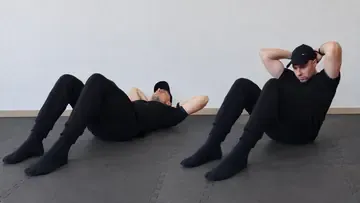
Set your position
Lie on your back with your knees bent and your feet flat on the floor. Keep your feet around hip width apart and place your arms across your chest or in another comfortable position.
 dynamic
Lie on your back with your knees bent and your feet planted on the floor. Brace your core and begin by curling your rib cage towards your pelvis, then continue raising your torso until you reach an upright or near-upright position. Lower yourself back to the floor with control rather than dropping backwards. Keep your neck relaxed and avoid using your arms or excessive momentum to throw yourself through the movement.
Lie on your back with your knees bent and your feet flat on the floor. Keep your feet around hip width apart and place your arms across your chest or in another comfortable position.
Engage your abdominals before leaving the floor and keep your neck relaxed as you prepare to raise your torso.
Begin by bringing your rib cage towards your pelvis, lifting your head, shoulders, and upper back from the floor as one controlled movement.
Continue raising your torso towards your thighs until you reach the top of the movement. Keep your feet planted and avoid throwing your arms forward for momentum.
Reverse the movement and gradually lower your torso back towards the floor. Maintain control until your upper back returns to the starting position.
Avoid throwing your torso forward to complete the repetition. Move smoothly enough that your abdominal and hip muscles control the movement rather than relying on momentum.
If your hands are positioned near your head, do not pull your head forward. Keep your neck relatively relaxed and allow it to follow the movement of your torso.
Do not relax at the top and fall backwards. Control the entire lowering phase until your torso returns to the floor.
Aggressively swinging your arms can provide enough momentum to make the repetition considerably easier. Keep your arm position consistent throughout the movement.
A Sit Up uses a larger range of motion than a Crunch. Do not stop as soon as your shoulder blades leave the floor if your goal is to perform the full Sit Up.
Sit Ups are a dynamic core exercise performed by raising your torso from a lying position towards your thighs and then lowering yourself back to the floor under control.
The abdominals contribute to flexing and controlling the trunk, while the hip flexors become increasingly involved as the torso continues towards the thighs. The obliques also assist with trunk control.
A Crunch primarily curls the rib cage towards the pelvis and lifts only the upper back from the floor. A Sit Up continues through a much larger range until most of the torso has been raised, which increases the contribution of the hip flexors.
It is not necessary for the basic bodyweight version. Keeping your feet unanchored can help you learn to control the movement without relying heavily on an external support.
Start with Crunches to develop trunk flexion strength, use a smaller Sit Up range, or extend your arms forward to provide a small counterbalance. Gradually increase the range as your control improves.