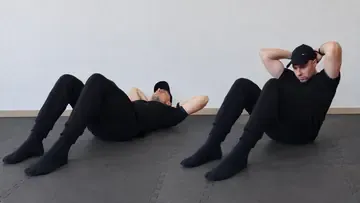
Set your position
Lie on your back with your hands lightly behind your head. Lift your shoulders from the floor and bring your knees into a bent position above your hips.
 dynamic
Lie on your back with your hands lightly supporting your head and lift your legs from the floor. Bring one knee towards your chest while extending the opposite leg, then rotate your torso so the opposite shoulder moves towards the bent knee. Switch sides in a smooth and controlled motion. Focus on rotating through your torso rather than pulling your elbow across with your arm, and avoid rushing the pedaling movement.
Lie on your back with your hands lightly behind your head. Lift your shoulders from the floor and bring your knees into a bent position above your hips.
Extend one leg away from your body while keeping it elevated from the floor. At the same time, bring the opposite knee towards your chest.
Rotate through your trunk and bring the opposite shoulder towards the bent knee. Think about moving your rib cage towards the opposite side rather than simply moving your elbow.
Begin extending the bent leg as the other knee comes towards your chest. Rotate your torso in the opposite direction with the same controlled motion.
Alternate from side to side while keeping your shoulders elevated and your movement controlled. Maintain a steady rhythm without turning the exercise into a fast pedaling motion.
Your hands should only provide light support for your head. Do not pull your head forward to create the illusion of a larger crunch.
Bringing an elbow towards the opposite knee without rotating the torso misses an important part of the exercise. Lift and rotate the shoulder and rib cage towards the opposite side.
Rapidly kicking the legs back and forth often replaces controlled abdominal work with momentum. Slow the movement down enough to clearly control each rotation.
Avoid completely relaxing your shoulders onto the floor every time you switch sides. Maintain abdominal tension as you transition from one rotation to the other.
Do not force the straight leg extremely close to the floor if you cannot control your trunk position. Keep it higher and gradually increase the lever as your core strength improves.
Bicycle Crunches are an alternating abdominal exercise that combines a crunch with torso rotation and a cycling motion of the legs. One knee moves towards the body while the opposite shoulder rotates towards it.
The rectus abdominis and obliques are the main abdominal muscles involved. The hip flexors also help move the legs, while other core muscles contribute to controlling the trunk throughout the exercise.
It can, but making contact is not the main objective. Focus on rotating your torso and bringing your shoulder towards the opposite knee rather than forcing the elbow across your body just to touch it.
The hip flexors actively move and support your legs during the cycling motion, so some involvement is normal. Slow the exercise down and focus on abdominal flexion and torso rotation instead of only moving your legs.
Keep the extended leg higher from the floor, reduce the range of the leg movement, and perform each side slowly. You can also build abdominal control first with regular Crunches before returning to the alternating version.