Establish a neutral grip
Grip two parallel handles with your palms facing each other. Use a comfortable hand spacing, typically close to shoulder-width, and ensure the equipment is secure.
 dynamic
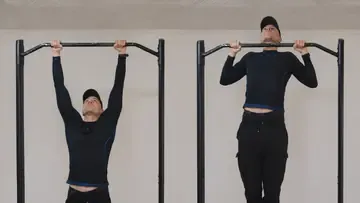
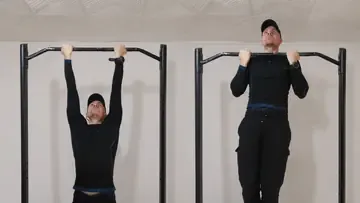
Grip a pull-up station with parallel handles so that your palms face each other. Begin hanging with your arms fully extended, shoulders controlled, and feet suspended above the ground. Engage your core and initiate the pull by coordinating your shoulder blades and elbow flexors. Pull your body upwards until your chin reaches or passes the height of the handles, without excessively extending your neck. Lower yourself slowly until your elbows are fully extended again. Maintain a stable torso, avoid swinging, and perform each repetition through a controlled range of motion.
Grip two parallel handles with your palms facing each other. Use a comfortable hand spacing, typically close to shoulder-width, and ensure the equipment is secure.
Hang with your arms fully extended and your feet off the ground. Engage your abdominals and glutes to maintain a stable body position.
Begin pulling by engaging your back muscles and bending your elbows. Keep your shoulders controlled and avoid swinging your legs to generate momentum.
Continue pulling until your chin reaches or passes the height of the handles. Keep your elbows moving naturally towards your sides and avoid excessively extending your neck.
Slowly extend your elbows and return to the starting hang. Maintain shoulder control throughout the descent and avoid dropping abruptly.
Avoid swinging your legs or kicking your hips to lift your body. Perform the movement using controlled back and arm strength.
Avoid performing only partial repetitions. Start from full elbow extension and pull upwards through the available controlled range.
Do not reach your chin towards the handles by tilting your head backwards. Keep your neck relatively neutral and lift your body through the pulling movement.
Avoid shrugging excessively or allowing uncontrolled shoulder movement during the pull. Coordinate scapular movement naturally throughout the repetition.
Do not release tension abruptly during the lowering phase. Control the descent until your arms are fully extended.
An excessively narrow or wide neutral grip can make the movement awkward. Choose parallel handles that allow a comfortable position for your wrists, elbows, and shoulders.
A Neutral Grip Pull Up is a Pull Up variation performed with the palms facing each other on parallel handles. The athlete pulls the body upwards from a hanging position while keeping the grip neutral.
Neutral Grip Pull Ups primarily train the latissimus dorsi, upper back, and elbow flexors, including the biceps and brachialis. The forearms and core muscles also contribute to grip and body stabilization.
Many athletes find Neutral Grip Pull Ups more comfortable or slightly easier than overhand Pull Ups because of the grip position and elbow mechanics. However, the actual difficulty depends on individual strength, handle spacing, and technique.
Neutral Grip Pull Ups use palms facing each other, while Chin Ups use an underhand grip with the palms facing towards the athlete. Both train the back and elbow flexors, but the forearm and shoulder positions differ.
A neutral grip may feel more comfortable for some athletes because it avoids the fully pronated or supinated forearm positions. However, comfort varies, and the exercise should not be forced through wrist, elbow, or shoulder pain.
Use an assistance band, an assisted Pull Up machine with neutral handles, or partial foot support. Gradually reduce assistance as your pulling strength improves.
Yes. They develop general upper-body pulling strength that transfers to other Pull Up variations. However, practicing the specific grip you want to improve is also important.