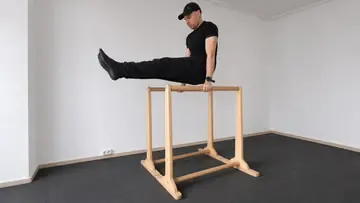
Establish the L-Sit
Begin in a controlled L-Sit with your elbows locked, hips completely off the floor, and both legs straight in front of you.
 static
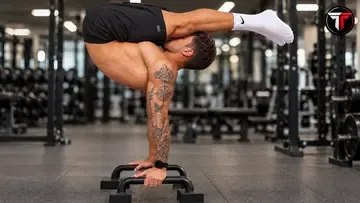
The V-Sit is the next major progression beyond the L-Sit. Support your body on locked arms, press strongly through your hands, and lift your straight legs above the horizontal L-Sit position. As the legs rise, allow your torso to lean backwards slightly to maintain balance while continuing to compress the thighs towards your chest. The challenge comes from combining strong active compression with straight knees, elevated hips, and stable straight-arm support.
Begin in a controlled L-Sit with your elbows locked, hips completely off the floor, and both legs straight in front of you.
Push strongly into the floor or parallettes and keep your shoulders active. Maintain straight elbows as you prepare to raise your legs higher.
Pull your thighs closer towards your torso while keeping your knees extended. Raise both feet progressively above the horizontal L-Sit position.
Allow your torso to lean slightly backwards as the legs rise. Keep your hips suspended, legs together, and knees locked while finding a balanced V-shaped position.
Maintain the highest leg position you can control without bending your knees or collapsing through your arms. Lower back towards the L-Sit under control when your position begins to break.
Bent knees reduce the compression and mobility demands of the full V-Sit. Use a Tuck or One-Leg V-Sit progression if you cannot yet keep both knees extended.
Leaning the torso back without actively raising the legs can create the appearance of a tighter angle without developing the required compression. Actively pull your straight legs higher towards your torso.
The V-Sit is a straight-arm support skill. Keep your elbows locked and press strongly through your hands rather than sinking between your shoulders.
Your legs do not need to reach vertical for the position to qualify as a V-Sit. First develop a clean position above horizontal, then progressively increase the leg height as your compression and mobility improve.
The V-Sit is a static support skill where you hold your body above the floor on straight arms while keeping both straight legs raised above horizontal. It is a more compressed progression of the L-Sit.
In an L-Sit, the legs are held approximately horizontal. In a V-Sit, both straight legs are raised clearly above horizontal towards the torso, requiring greater active compression and usable hamstring flexibility.
No. The defining progression from an L-Sit is that the straight legs rise clearly above horizontal. Raising them progressively closer to vertical makes the position harder and can eventually lead towards an I-Sit.
The V-Sit requires substantially more active compression. You need enough hip-flexor strength and hamstring mobility to pull your straight legs higher while continuing to support your entire body on locked arms.
Start from a strong L-Sit and train active compression separately. Then use High Tuck V-Sits, One-Leg V-Sits, and progressively higher straight-leg holds until both legs can remain clearly above horizontal.