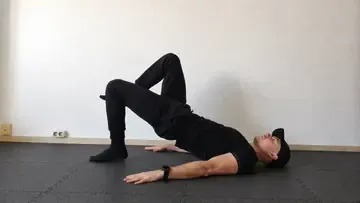
Set your working leg
Lie on your back with one knee bent and the working foot flat on the floor. Lift the opposite leg and brace your abdominals before beginning the movement.
 dynamic
The Single Leg Glute Bridge is a natural progression from the regular Glute Bridge. Lie on your back, keep one foot planted, lift the opposite leg, and drive your hips upward using the working glute. The main challenge is not simply lifting as high as possible, but extending the hip without arching your lower back or allowing one side of your pelvis to drop or rotate. Train both sides and prioritize controlled hip extension over extra range of motion.
Lie on your back with one knee bent and the working foot flat on the floor. Lift the opposite leg and brace your abdominals before beginning the movement.
Press the working foot firmly into the floor and contract the glute to begin extending your hip. Keep your upper back and shoulders in contact with the ground.
Raise your pelvis until your working hip reaches a strong extended position. Keep both sides of your pelvis controlled instead of allowing the unsupported side to drop or rotate.
Squeeze the working glute at the top without forcing your hips higher by arching your lower back. Maintain abdominal tension throughout the top position.
Slowly lower your hips towards the floor while maintaining pelvic control. Complete your repetitions with one leg before switching sides.
The unsupported side of the pelvis often drops or rotates as you lift. Keep your hips controlled and approximately level instead of using rotation to create extra height.
Do not chase maximum height by extending through your lumbar spine. Stop when your hip reaches extension and your glute is fully contracted while your trunk remains controlled.
If your hamstrings constantly cramp or dominate the movement, adjust your foot position and focus on driving hip extension with the glute. Bringing the working foot somewhat closer can reduce hamstring contribution for some people.
Your arms and shoulders can provide stability, but they should not create the movement. Generate the lift by pressing through the working leg and extending the hip.
The Single Leg Glute Bridge is a unilateral bridge where one foot remains on the floor while the opposite leg is elevated. The working leg extends the hip and raises the pelvis while your trunk and pelvis resist unwanted rotation.
The glutes are the main target, while the hamstrings assist with hip extension. The abdominal and oblique muscles help stabilize the trunk and pelvis as you perform the movement on one leg.
The hamstrings also extend the hip, so some hamstring activity is normal. If they dominate or cramp, experiment with bringing the working foot closer to your hips and focus on maintaining abdominal tension while actively contracting the glute.
Yes. Try to keep both sides of your pelvis controlled throughout the repetition. A major hip drop or rotation usually means the unilateral position is exceeding your current ability to stabilize the movement.
First increase your control through the full range of motion. From there, you can progress to the Single Leg Hip Thrust, where elevating the upper back allows a larger hip movement and provides more options for increasing the difficulty.