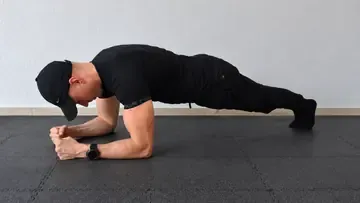
Set your forearm
Lie on your side and place your forearm on the floor with your elbow approximately underneath your shoulder. Keep the supporting shoulder active instead of collapsing into it.
 static
The Side Plank develops lateral core stability rather than simply training the abdominals through movement. Stack your elbow beneath your shoulder, extend your legs, and lift your hips until your head, torso, hips, and feet form a controlled line. Keep the pelvis elevated and avoid rotating your chest towards the floor. Train both sides and prioritize a stable position over holding for as long as possible.
Lie on your side and place your forearm on the floor with your elbow approximately underneath your shoulder. Keep the supporting shoulder active instead of collapsing into it.
Straighten both legs and stack your feet, or use a slightly staggered foot position while learning the exercise. Keep your body aligned before lifting your hips.
Press through your forearm and feet while lifting your hips away from the floor. Create a long line through your head, shoulders, hips, knees, and ankles.
Brace your core and glutes while keeping your chest facing forward. Avoid allowing your pelvis to rotate towards the floor or excessively backwards.
Maintain the position while breathing normally, then repeat on the opposite side. End the hold when you can no longer keep your hips elevated and your torso controlled.
As fatigue increases, the pelvis often begins to sag towards the floor. End the hold or use an easier variation when you can no longer maintain a straight lateral body position.
Turning your chest and pelvis down changes the position and reduces the lateral stability challenge. Keep your torso controlled and approximately perpendicular to the floor.
Do not let your supporting shoulder sink towards your ear or carry the position passively. Press actively through your forearm and maintain space through the shoulder throughout the hold.
Extra seconds are not useful if your hips have dropped or your torso has rotated. Prioritize a shorter, controlled hold and progress the exercise when maintaining good alignment becomes easy.
The Side Plank is a static core exercise performed on one side of the body. You support yourself on one forearm and your feet while keeping the hips elevated and the torso stable.
The obliques are heavily involved in maintaining the lateral trunk position. The rest of the abdominal wall, glutes, shoulder stabilizers, and serratus also contribute to keeping the pelvis, torso, and supporting shoulder controlled.
Your supporting shoulder must stabilize a significant portion of your bodyweight, so some muscular effort there is expected. Keep the elbow beneath the shoulder and actively press through the forearm instead of sinking into the joint.
Both positions are useful. Staggering the feet creates a larger base of support and can make balance easier, while stacking the feet narrows the base and increases the stability challenge. Use the position that lets you maintain good alignment.
Progress from a stable forearm Side Plank to stacked feet, longer lever positions, controlled hip movements, or variations where the upper leg is lifted. Increase difficulty only while you can maintain your hip and shoulder position.