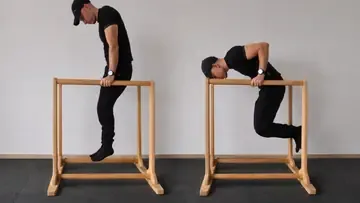
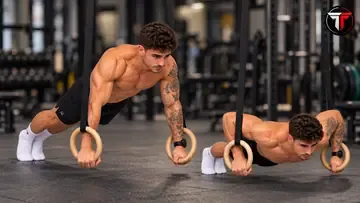
Establish ring support
Grip both rings and establish a stable support position with your arms fully extended and your feet off the ground. Keep the rings close to your hips, shoulders active, and core engaged.
 dynamic
Begin in a stable support position above two gymnastics rings with your arms fully extended, shoulders controlled, and feet suspended above the ground. Keep the rings close to your sides and engage your core to prevent excessive swinging. Slowly bend your elbows and lower your body between the rings, allowing a slight forward torso lean while maintaining shoulder stability. Descend through a comfortable range, typically until your shoulders approach elbow height if your mobility and control allow it. Press firmly through both rings to extend your arms and return to the support position. Keep the rings stable throughout the movement and avoid excessive outward drifting or uncontrolled shoulder extension.
Grip both rings and establish a stable support position with your arms fully extended and your feet off the ground. Keep the rings close to your hips, shoulders active, and core engaged.
Maintain a controlled upright position with a slight forward torso lean. Keep your elbows close to your body and prevent the rings from swinging or moving excessively outward.
Slowly bend your elbows and lower your body between the rings. Keep your shoulders stable and descend only as far as you can comfortably control.
Push firmly through both rings and extend your elbows to raise your body. Keep the rings close to your sides and avoid using your legs or momentum to assist the movement.
Return to the top position with your arms fully extended, shoulders controlled, and feet suspended. Stabilize the rings before beginning the next repetition.
Letting the rings separate excessively increases the demand on the shoulders and reduces control. Keep them relatively close to your body throughout the repetition.
Avoid collapsing into your shoulders or allowing uncontrolled movement at the bottom. Maintain active shoulder control and use a comfortable range of motion.
Lowering beyond your available shoulder mobility can place unnecessary stress on the joints. Do not force a deep position if you cannot maintain stability.
Avoid kicking your legs or using momentum to rise. Keep your core engaged and perform the movement with controlled upper-body strength.
Allowing your elbows to move too far outward can make the rings harder to stabilize. Keep your elbows relatively close to your torso during the descent and ascent.
Do not finish with partially bent elbows or unstable rings. Return to controlled full elbow extension without forcefully hyperextending the joints.
A Ring Dip is a bodyweight pushing exercise performed while suspended above two gymnastics rings. The athlete lowers the body by bending the elbows and then presses back to a stable support position.
Ring Dips primarily train the triceps, pectorals, and anterior deltoids. The upper back, forearms, and core muscles help stabilize the rings and maintain body control.
Generally, yes. Gymnastics rings move independently and require additional shoulder stabilization and coordination, making Ring Dips more demanding than equivalent Dips on fixed parallel bars.
Build strength with regular Dips and Ring Push Ups, then practice stable ring support holds. Assisted Ring Dips with your feet supported can help you develop control before performing full repetitions.
Lower through a controlled and comfortable range. Reaching approximately shoulder-to-elbow height is a useful reference for many athletes, but depth should be limited by individual shoulder mobility and stability.
A slight rings-turned-out support can develop additional stability, but it is not required for a basic Ring Dip. Beginners should first learn to maintain a secure, neutral support position.
Yes. Ring Dips strengthen the pressing phase of the Ring Muscle Up and develop stability in the support position. However, the pulling and transition phases must also be trained separately.