Set your starting position
Stand with your feet on the floor and fold forward to place your hands approximately shoulder-width apart. Keep your elbows straight and bring your hips high above your feet.
 dynamic
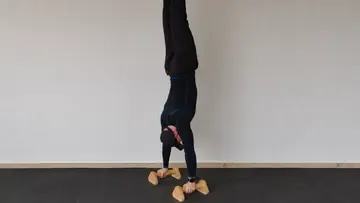
Begin standing in a forward fold with your hands planted firmly on the floor and your legs extended. Shift your shoulders forward beyond your hands while pushing strongly through straight arms. Transfer your bodyweight onto your hands and gradually lift your feet from the floor without jumping. Keep your hips elevated and your legs controlled as you rotate your pelvis over your shoulders. Once your hips are stacked above your hands, extend your legs upward until you reach a fully aligned Handstand. This movement requires a combination of shoulder strength, hamstring flexibility, hip compression, and precise balance.
Stand with your feet on the floor and fold forward to place your hands approximately shoulder-width apart. Keep your elbows straight and bring your hips high above your feet.
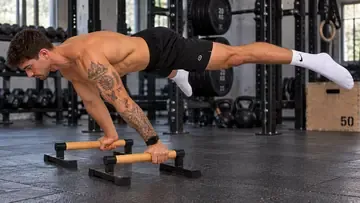
Shift your shoulders forward beyond your wrists while actively pushing the floor away. Maintain straight arms and engage your core to prepare for the weight transfer.
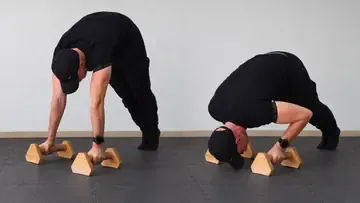
Gradually transfer your weight onto your hands and lift both feet from the floor without jumping. Keep your hips elevated and maintain a compact, controlled body position.
Continue elevating your pelvis until it stacks above your shoulders. Progressively extend your legs upward while controlling your balance through your hands and shoulders.
Bring your legs together and align your wrists, shoulders, hips, and ankles vertically. Keep your elbows locked, shoulders elevated, and core engaged to stabilize the Handstand.
Using a kick or jump removes the controlled strength component of the exercise. The Press To Handstand should be performed through a continuous weight transfer without momentum.
The standard Press To Handstand is a straight-arm movement. Bending the elbows changes the mechanics and reduces the intended shoulder strength demand.
Trying to straighten your legs upward before your hips have risen sufficiently can make the movement unnecessarily difficult. Prioritize lifting and stacking your pelvis first.
Avoid sinking into your shoulders during the press. Maintain active scapular elevation and push firmly through the floor throughout the transition.
Insufficient abdominal and hip flexor engagement can make it difficult to lift the feet and control the pelvis. Maintain a strong compressed position during the initial phase.
A Press To Handstand is a controlled movement where the athlete lifts the body from the floor into a Handstand using shoulder strength, flexibility, and balance without kicking or jumping.
The anterior deltoids and serratus anterior provide shoulder support and control, while the abdominals and hip flexors help lift and position the pelvis and legs. The triceps and forearms contribute to arm stability and balance.
Generally, yes. A regular Handstand requires balance and overhead stability, while a Press To Handstand additionally demands significant straight-arm strength, active flexibility, and controlled compression.
Good hamstring flexibility is very helpful because it allows the hips to rise while the feet remain close to the hands. Limited flexibility can make the weight transfer more difficult and increase the strength required.
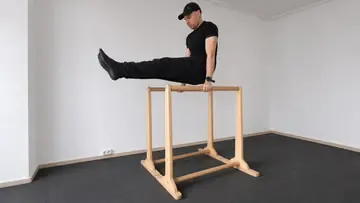
Develop a stable Handstand, practice Planche Leans and compression exercises, and use elevated surfaces or partial presses to reduce the difficulty. Gradually decrease assistance while keeping the arms straight and eliminating momentum.