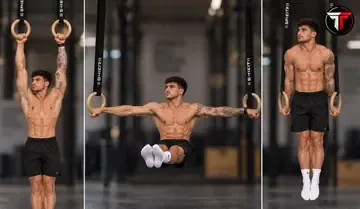
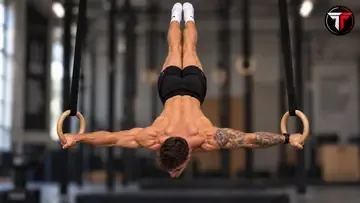
Establish the inverted hang
Begin hanging upside down between the rings with your body straight, legs together, and elbows fully extended. Stabilize your shoulders and prevent unnecessary swinging.
 dynamic
Begin in a stable inverted hang with your body vertical, legs together, and elbows completely extended. Without swinging or bending your arms, generate force through your shoulders to raise your inverted body while progressively opening the rings outward. Maintain a straight body line and avoid excessive back arching or allowing your hips to move ahead of your shoulders. Continue until your arms reach the lateral Inverted Cross position, then stabilize the hold. This is an exceptionally demanding rings skill that requires an established Inverted Cross and extensive preparation for straight-arm shoulder loading.
Begin hanging upside down between the rings with your body straight, legs together, and elbows fully extended. Stabilize your shoulders and prevent unnecessary swinging.
Begin raising your inverted body using controlled shoulder strength. Keep both elbows locked and avoid bending your arms to create momentum.
Gradually move your arms outward as your body rises. Maintain symmetrical shoulder movement and keep your torso aligned with your hips and legs.
Continue the straight-arm transition until your arms approach a horizontal position at your sides. Avoid arching your back or allowing your body to travel diagonally.
Finish in a stable Inverted Cross with your body vertical and upside down, both arms extended laterally, and elbows completely locked. Maintain control without relying on momentum.
The movement is defined by straight-arm strength. Bending your elbows to generate additional force changes the mechanics and reduces the difficulty of the transition.
Avoid creating a large arch through your lower back to shorten the effective lever. Keep your ribs, pelvis, and legs aligned throughout the movement.
A slashed or diagonal body path reduces the intended vertical strength demand. Keep your body aligned as you rise from the inverted hang towards the Inverted Cross.
Do not rely on swinging or rebounding to pass through the hardest portion. The strict variation requires a controlled strength transition rather than momentum.
Reaching the final position momentarily is not enough for a complete controlled execution. Establish a recognizable Inverted Cross without bending the elbows or losing your body line.
The Inverted Butterfly is an elite straight-arm gymnastics rings movement where the athlete rises from an inverted hang into an Inverted Cross without bending the elbows.
The straight-arm strength rise from inverted hang to Inverted Cross was performed by Ilya Zaika at the 2026 Paris World Challenge Cup and recognized under his name. Inverted Butterfly remains a useful descriptive name for the movement.
The anterior and middle deltoids are major contributors to the shoulder movement, while the biceps experience substantial straight-arm loading. The upper back, chest, lats, and core contribute to stability and body alignment.
The regular Butterfly begins from a normal dead hang and moves through an Iron Cross towards ring support in the full variation used by Treethenics. The Inverted Butterfly begins upside down and rises into an Inverted Cross, placing a different and exceptionally high demand on the shoulders.
A strong and stable Inverted Cross is essential. Advanced straight-arm rings strength, shoulder mobility, and experience with controlled negative transitions are important foundations. The full movement should only be approached with specialist coaching and appropriate assistance.