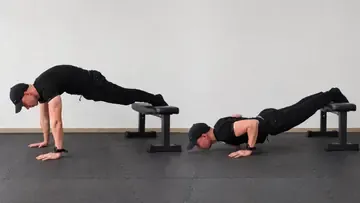
Choose an elevated surface
Stand facing a stable bench or elevated platform. Place your hands approximately shoulder-width apart and ensure the surface cannot move during the exercise.
 dynamic
Place your hands approximately shoulder-width apart on a stable elevated surface such as a bench or low bar. Walk your feet backwards until your body forms a straight inclined line from head to heels. Brace your core and bend your elbows to lower your chest towards the surface while keeping your shoulders controlled. Push through your palms to extend your arms and return to the starting position. Begin with a higher surface if necessary, then gradually reduce the elevation as your pushing strength improves.
Stand facing a stable bench or elevated platform. Place your hands approximately shoulder-width apart and ensure the surface cannot move during the exercise.
Walk your feet backwards until your body forms a straight inclined line from your shoulders to your heels. Keep your legs extended and engage your core and glutes.
Bend your elbows and slowly lower your chest towards the elevated surface. Allow your elbows to travel slightly backwards rather than flaring directly out to the sides.
Press firmly through your palms and extend your elbows to raise your body. Maintain a stable torso and avoid pushing your hips upwards separately.
Finish with your arms extended and your body aligned from head to heels. Maintain control before beginning the next repetition.
Allowing your hips to drop creates excessive lower-back extension. Keep your abdominals and glutes engaged to maintain a straight body line.
Avoid pushing your hips upwards into a pike position. Your shoulders, hips, and ankles should remain approximately aligned throughout the movement.
Do not allow your elbows to point directly outwards at shoulder height. Use a comfortable elbow angle and keep your shoulders controlled during the descent.
Avoid benches, chairs, or other objects that can slide or tip over. Always choose a secure support capable of safely holding your bodyweight.
Lower your chest towards the elevated surface through a comfortable, controlled range rather than stopping after only a small elbow bend.
If you cannot maintain proper alignment or control the descent, use a higher surface to reduce the resistance before progressing.
An Incline Push Up is a Push Up variation performed with the hands on an elevated surface and the feet on the floor. The incline reduces the load on the upper body compared with a standard Push Up.
Incline Push Ups primarily work the pectorals, triceps, and anterior deltoids. The serratus anterior and core muscles help stabilize the shoulders and maintain body alignment.
Yes. Raising the hands reduces the proportion of bodyweight supported by the arms. A higher surface generally makes the exercise easier, while a lower surface makes it more challenging.
Yes. They allow beginners to practice the full Push Up movement with adjustable resistance, making them a useful way to build strength and technique before attempting floor Push Ups.
Gradually lower the height of the supporting surface while maintaining full range of motion and a straight body line. Eventually, progress to standard Push Ups on the floor.
Incline Push Ups elevate the hands and generally reduce upper-body loading. Decline Push Ups elevate the feet and generally increase the load on the shoulders and upper body.