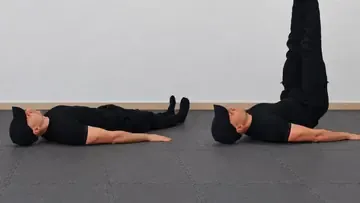
Lie on your back
Lie face-up on the floor with your legs extended and your arms alongside your body. Keep your head and shoulders relaxed in a comfortable position.
 dynamic
Lie on your back on a comfortable surface with your legs extended and your arms resting alongside your body. Engage your abdominal muscles and gently tilt your pelvis backwards to limit excessive lower-back arching. Lift both legs slightly above the floor while keeping your knees straight or nearly straight. Begin alternating small vertical kicks, raising one leg while lowering the other without allowing either foot to touch the ground. Maintain a steady rhythm, controlled breathing, and stable torso position throughout the exercise. Keep the movements relatively small and avoid using momentum. If maintaining a comfortable lower-back position becomes difficult, raise your legs higher, bend your knees slightly, or take a break.
Lie face-up on the floor with your legs extended and your arms alongside your body. Keep your head and shoulders relaxed in a comfortable position.
Tighten your abdominal muscles and gently tilt your pelvis backwards to maintain a controlled lower-back position.
Raise both straight legs slightly above the floor. Keep your feet suspended and maintain abdominal tension before starting the kicks.
Raise one leg while lowering the other in a small, controlled vertical movement. Keep your knees nearly straight and prevent your lower back from arching excessively.
Continue alternating your legs without touching the floor. Breathe naturally, maintain pelvic control, and stop when you can no longer preserve proper technique.
Avoid excessive lumbar extension as your legs move. Maintain abdominal engagement and raise your legs higher if you cannot control your pelvic position.
Moving the legs excessively fast can reduce muscular control and increase unwanted movement through the pelvis. Use a steady and deliberate rhythm.
Avoid turning the exercise into large alternating leg raises. Flutter Kicks use relatively small vertical movements while the legs remain elevated.
Keep your knees straight or nearly straight to maintain the intended movement. Significant knee bending changes the exercise and reduces the lever length.
Avoid breath-holding throughout the set. Maintain controlled, natural breathing while keeping your abdominal muscles engaged.
Do not allow your pelvis to rock from side to side or repeatedly tilt during the kicks. Keep your torso stable while the legs alternate.
Stop or modify the exercise when you can no longer maintain a comfortable lower-back position or controlled leg movement.
Flutter Kicks are a bodyweight core exercise performed while lying on the back with both legs raised slightly above the floor. The athlete alternates small vertical leg movements while maintaining a stable torso.
Flutter Kicks challenge the abdominal muscles to stabilize the pelvis and torso while the hip flexors produce the alternating leg movements. The quadriceps help maintain knee extension.
Flutter Kicks engage the rectus abdominis to help stabilize the pelvis and resist excessive lower-back arching. They do not isolate a separate lower abdominal muscle.
Keep your legs slightly above the floor at a height that allows you to maintain abdominal tension and comfortable lower-back positioning. Raising the legs higher generally reduces the difficulty of controlling the pelvis.
Aim to maintain a controlled, comfortable lower-back position without excessive arching. A gentle posterior pelvic tilt can help, but avoid forcefully pressing your spine into the floor if it causes discomfort.
Neither exercise is universally better. Flutter Kicks emphasize sustained core stabilization and alternating hip movement, while Leg Raises involve a larger bilateral lifting motion. Both can be useful depending on your training goals.
Raise your legs higher, slightly bend your knees, reduce the movement speed, or perform shorter sets. Progress by gradually increasing control and duration.
Choose a duration that allows consistent technique and controlled breathing. Begin with short sets and gradually increase the time as your abdominal endurance improves.