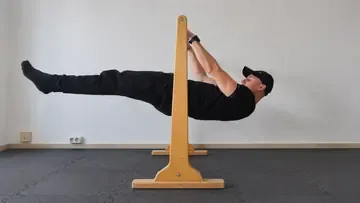
Set up a secure anchor
Lie on a sturdy bench or padded surface and firmly grip a secure support behind your head. Use your hands and upper body to create a stable anchor, but keep the load across your shoulders and upper back rather than your neck.
 dynamic
The dragon flag is much more than a difficult leg raise. Your shoulders stay anchored while your torso, hips, and legs move together as one long lever. Start with tucked variations and controlled negatives before gradually extending your legs. The closer a straight body gets to horizontal, the greater the leverage and the harder your core must work to maintain position. Only lower as far as you can without folding at the hips or losing control of your lower back.
Lie on a sturdy bench or padded surface and firmly grip a secure support behind your head. Use your hands and upper body to create a stable anchor, but keep the load across your shoulders and upper back rather than your neck.
Bring your knees towards your chest and curl your pelvis away from the bench. Lift your hips until your weight is supported through your shoulders and upper back, then practice controlling the position with your knees bent.
Gradually extend your legs as your control improves. Progress from a tuck to one-leg, straddle, or straight-leg variations rather than immediately attempting the full lever.
Brace your abs, squeeze your glutes, and slowly lower your shoulders-to-feet body line towards horizontal. Keep your hips extended and stop the descent as soon as your lower back begins to arch or your body folds at the hips.
From your lowest controlled position, maintain the same rigid body shape and raise yourself back towards vertical. If you cannot yet lift the full lever, perform controlled negatives and reset with a shorter-lever position.
Do not turn the dragon flag into a straight-leg raise. Your torso and legs should behave like one connected lever. If your hips fold as you approach the floor, shorten the lever or reduce your range of motion.
Keep your abs and glutes engaged as the leverage increases. Stop the descent before your ribs flare and your lower back falls into excessive extension. A higher but controlled dragon flag is better than reaching horizontal with a broken body line.
The lowering phase is one of the most useful parts of the exercise. Resist gravity throughout the descent instead of allowing your hips and legs to suddenly fall towards the bench.
Your shoulders and upper back should provide the support against the bench or floor. Do not balance your bodyweight on your neck or use your head as the main contact point.
The dragon flag primarily challenges your abdominal wall to maintain a rigid trunk and resist lower-back extension. Your obliques contribute to trunk stability, while your lats and arms help anchor the upper body and your glutes and quadriceps keep the hips and knees extended.
No. In a leg raise, your legs move relative to a comparatively stable torso. During a strict dragon flag, your torso, hips, and legs move together as one rigid lever while your shoulders and upper back remain anchored.
Start with strong hollow body control, then practice tuck dragon flags and slow negatives. Gradually increase the lever with one-leg, straddle, or partially extended variations until you can lower and raise a straight body without bending at the hips or arching your lower back.
The negative is easier to control than reversing the full lever back upwards. This is normal while learning. Keep training slow negatives and shorter-lever repetitions rather than using momentum or breaking your body position to complete the upward phase.