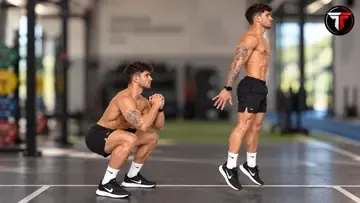
Lower to the floor
From standing, bend your knees and hips to lower your body and place both hands firmly on the floor in front of your feet.
 dynamic
Start from a standing position, bend your knees, and place your hands on the floor in front of you. Jump your feet backwards into a strong plank position, then quickly bring them forward again underneath your body. Rise from the squat and finish with a controlled vertical jump before beginning the next repetition. Keep your trunk stable when your feet move backwards and focus on smooth transitions rather than rushing through each phase with poor body control.
From standing, bend your knees and hips to lower your body and place both hands firmly on the floor in front of your feet.
Jump both feet backwards and land in a strong plank position with your hands underneath or close to your shoulders.
Keep your trunk braced and avoid allowing your hips to collapse towards the floor when your legs reach the plank position.
Jump both feet forward towards your hands and return to a compact squat position while keeping your feet firmly planted.
Drive through your legs to stand and jump vertically. Land softly with slightly bent knees and immediately regain control before starting the next repetition.
When your feet jump backwards, do not allow your lower back to sag towards the floor. Brace your core and arrive in a controlled plank position.
Absorb the landing from the vertical jump through your ankles, knees, and hips instead of landing with completely straight legs.
Trying to move as fast as possible can turn the transition into an uncontrolled fall towards the floor. Place your hands securely and maintain control as your feet move backwards.
When returning from the plank, bring your feet far enough forward to establish a strong position for standing and jumping instead of trying to jump vertically from an excessively stretched position.
A standard Treethenics Burpee does not require your chest to touch the floor. If you perform a Push Up at the bottom, treat it as a separate and more demanding variation rather than changing technique from repetition to repetition.
A Burpee is a full-body conditioning exercise that repeatedly moves you from standing to a plank position and back to standing, usually finishing with a vertical jump.
There are several accepted Burpee variations. In Treethenics, the standard Burpee moves from plank directly back towards the squat without a Push Up. Adding a Push Up is a harder variation that increases the upper-body demand.
Burpees involve much of the body. The quadriceps and glutes produce most of the force when standing and jumping, while the calves contribute to the jump and the shoulders, triceps, and core stabilize the plank position.
Burpees are commonly used for conditioning because they repeatedly move a large amount of body mass through several positions. Performing them continuously can raise heart rate quickly while also challenging muscular endurance.
Remove the final jump and step one foot backwards at a time instead of jumping into the plank. As your coordination and conditioning improve, reintroduce the jumping transitions.